
If you are an apparel manufacturer, then you must have experienced this at least once in your career. That is a missed deadline. It can be due to anything, not necessarily your team’s problem. It can happen when your cutting team goes slightly behind their deadline or even when your shipment arrives a bit late. Once something goes wrong, it starts a chain reaction, and the spillage is seen in other departments.
Suddenly you will see people working overtime to gain back the time lost. In the last three decades and more we have been in the woven fabric manufacturing business, we have seen this mistake happen with even experienced people. You won’t be able to identify the exact problem when it comes to missing deadlines in most cases, and you cannot blame your team for it. All you can blame is the production planning process.
If you are working with a poor production plan, then your processes are bound to fail, and that is the reason why we created this article to help you with six production planning and control strategies you can start to implement right away. If you are selecting the Best Fabrics for Fashion Design, then it will help you prevent many production issues before manufacturing even begins.
Download Digital Fabric Swatch Here
What Is Production Planning and Control?
A good production planning will help you organize each and every stage of the garment manufacturing process so that you can run it smoothly, avoiding delays.
It will help you lay out plans for what needs to be made, when you need to start various productions, and the raw materials required for it, as well as how to source them properly.
On the other hand, if you have a solid control on the process, it can help yo monitor the production, identify delay, maintain quality and help make sure that your timeline is on track.
For people who are new to apparel manufacturing, it is important to understand how fabrics are constructed. That is why we encourage you to check out our recent article on Types of Woven Fabric Explained
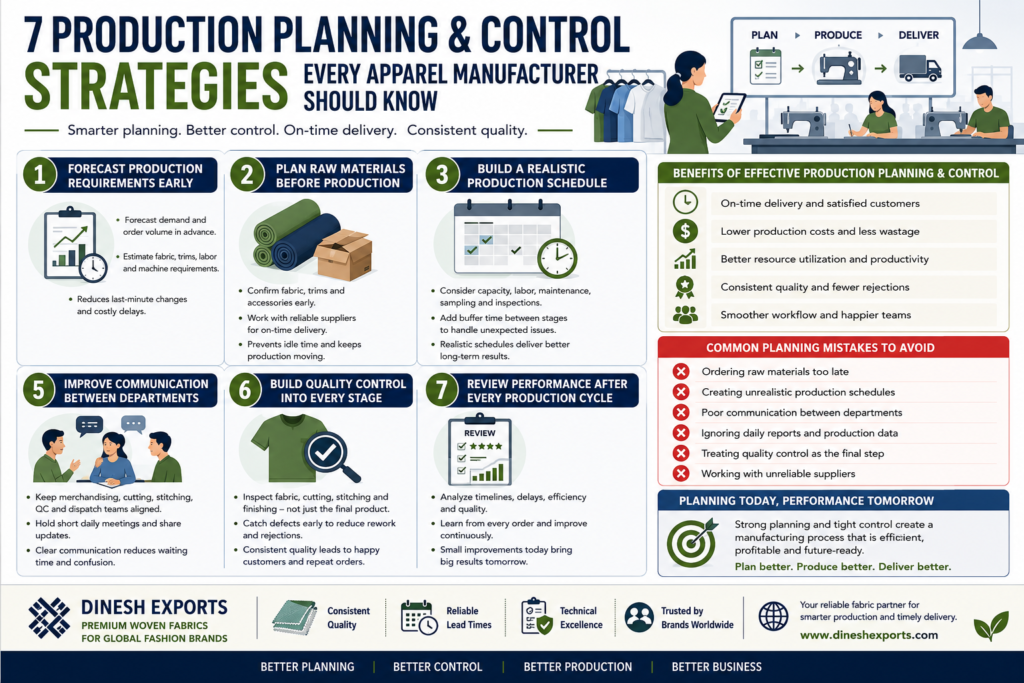
1. Forecast Production Requirements Early
Many manufacturers have not heard about forecasting expected production. It is a process where you calculate your expected manufacturing requirements and keep raw materials and other resources in place for the upcoming production. We have seen that most manufacturers never do this. They only start planning once their order is confirmed, which puts them behind already. Always calculate your estimation for the required woven fabrics, the number of machines you have at your facility, people and other resources before hand and be prepared.
Having this forecast can help you prepare for the upcoming orders and this way you can mitigate any risks before hand. If you are working with experienced manufacturers like Dinesh Exports, you will easy see that we have a robust forecasting methods that allows us to deliver your goods on time. If you’re looking for new suppliers to tie up with, check out our recent article on How to Choose the Right Sustainable Woven Fabric Manufacturer for Your Brand, it will help you choose the right manufacturer.
2. Plan Raw Materials Before Production Begins
With the war happening in the middle east and the whole supply chain being disrupted, it is easy to blame your shipping providers when you are not getting your goods on time. In order to avoid this situation, you need a robust plan for sourcing raw materials before production.
Garment manufacturers always complain about fabric delays and never about bad resource planning. Also you need to make sure that you have ample materials, trims, accessories, and other packaging items at hand before production begins.
If you are going with a woven fabric manufacturer like Dinesh Exports, then you can be sure that your fabrics arrive on time without any delay. Many manufacturers now look for sustainable fabrics specifically; if you are someone like that, then our article on Sustainable Woven Fabrics will be helpful to you in finding some of the best eco-friendly woven fabric options available today.
3. Build a Realistic Production Schedule
If you are creating a plan, then it should be realistic. And for that you need to consider your:
- machine capacity
- workforce availability
- maintenance schedules
- sampling requirements
- quality inspections
- unexpected disruptions.
Everyone wants to deliver the goods on time and maximize their output. But they often misread how much they can do without factoring in their resources. What we also recommend doing is adding more buffer between production stages. This will help you avoid any issues with delays up to a certain stage. Remember that realistic production planning is always better than an unrealistic deadline that puts everyone in your team in haste.
Also note that Fabric GSM and fiber composition directly influence production planning, cutting efficiency, and sewing performance.
4. Monitor Production Every Day
If you think you plan everything once and it’s done, then you are wrong. You need to keep track of all the deliverables and make sure that everything is moving as expected. As per the plan. Planning needs to be followed up on a daily basis. If anything is not moving or getting stuck, then the right steps need to be taken to move it ahead and keep the timelines safe.
If you monitor your plan regularly like this, then the chances of meeting deadlines are higher.
One thing to note here is that the quality of your raw materials can also influence your daily production performance. For example, if you understand the behavior of Cotton Blend Fabrics and Linen Blend Fabrics properly, then you can anticipate how different fabrics will behave during cutting, sewing, and finishing.
5. Improve Communication Between Departments
You are not playing a single 100-meter running game; you are playing a relay race with your team. The baton needs to be passed along from one department to another smoothly to avoid delays. I hope you understand the analogy I used to let you know the importance of proper communication between departments. It can bring in a lot of value to your team when everyone is looped in on how various projects are on the planning timeline.
If you let the stitching team know beforehand that the cutting process is going to be completed, then they can anticipate it and prepare accordingly. Likewise, all the various departments need to work and communicate efficiently like this. Notifications before, at the time, and after a process is finished and sent to the next team.
Which all team needs to communicate with each other:
- Merchandising
- Procurement
- Cutting
- Stitching
- Finishing
- Quality control
- Dispatch teams.
If you are working with an experienced Woven Fabric Manufacturer, you will see how having a proper communication system improves their production timelines
6. Build Quality Control Into Every Stage
Let me point this out: Quality control is not the last step in production. The one that happens before shipping. If you think it is, then you are wrong.
You need to incorporate quality control into each and every stage of your production. This way you can identify issues early, even before it reaches the quality control stage, saving you time and resources.
What Are The Common Production Planning Mistakes
We have seen experienced manufacturers facing planning challenges from time to time and the most common mistakes are:
- Ordering raw materials too late.
- Creating unrealistic production schedules.
- Poor communication between departments.
- Ignoring production data and daily reports.
- Treating quality control as the final step instead of an ongoing process.
- Working with unreliable suppliers that cause unnecessary delays.
If you avoid these common mistakes religiously, then chances are that you are going to be successful at meeting your clietn deadlines without a problem.
Final Thoughts
Production Planning and Control in Apparel Manufacturing is not only about creating schedules but also about making sure that you are following through on them on a daily basis. If you create a robust plan, then chances are that your various departments will start working together more easily due to improved communication, forecasting, planning, and setting realistic expectations. If you want to be a successful garment manufacturer, then you need good planning and control in place, rather than having a large facility. If you want to know more about our woven fabric capabilities, please contact us.
Frequently Asked Questions
What is production planning and control in apparel manufacturing?
It is a simple system in which garment manufacturers can make sure they meet their deadlines and deliver goods on time, considering unforeseen delays.
Why is production planning important in garment manufacturing?
It is used to get things done on time and to avoid delays.
What causes production delays in apparel factories?
Things like late raw material deliveries, poor scheduling, communication gaps between departments, machine breakdowns, and inadequate quality control can cause production delays.
How can manufacturers improve production efficiency?
Use forecasting, raw material planning, daily monitoring, and improve communication between departments to improve your efficiency.